Drug resistance, which occurs when bacteria, viruses, fungi, and parasites no longer respond to medicines intended to kill or weaken them, is an urgent threat to global health. As drug-resistant pathogens spread, diseases such as typhoid become harder to treat, making them more dangerous and imposing a health and economic burden on communities and health systems. The emergence and spread of extensively drug-resistant (XDR) typhoid, which is resistant to five classes of antibiotics, is especially alarming.
When it comes to stopping drug resistance, we all have a role to play. Preventing the spread of drug-resistant typhoid and other diseases requires action and collaboration among policymakers, researchers, health care providers, and individuals. Read on for three strategies to take on drug resistance and stop the spread of typhoid.
-
Typhoid conjugate vaccines: Fast, effective protection for children
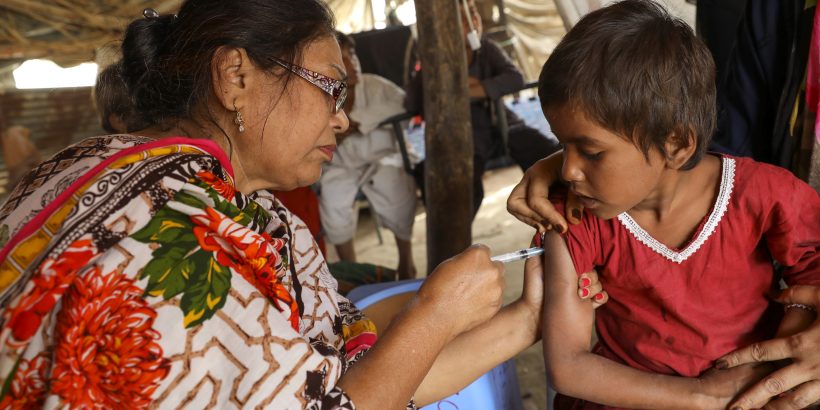
Typhoid conjugate vaccines (TCVs) can play a major role in preventing the spread of drug-resistant typhoid. TCVs, which can be given to children as young as 6 months of age, are highly effective against drug-resistant strains: one study in Hyderabad, Pakistan, found that TCVs were 97 percent effective against XDR typhoid in an outbreak setting.
Drug resistance is no longer a future challenge—it is a current threat. With TCVs, children gain strong protection against XDR typhoid and are less likely to fall ill, miss school, or experience dangerous complications like . With reduced infections and transmission, there are fewer opportunities for resistance to emerge, which leads to lower use of antibiotics, and ultimately to a lower prevalence of antibiotic resistance.
Nine Gavi-eligible countries have introduced TCVs into their routine immunization schedules, reaching nearly 150 million children during TCVs introduction campaigns. The latest World Health Organization (WHO) position paper on typhoid vaccines, published in 2026, offers guidance for countries on multiple delivery strategy options, including catch-up campaigns, vaccinating in hotspots, and vaccination for school-aged children. TCV are a crucial priority in places where drug resistant typhoid emerges and spreads.
-
Water, sanitation, and hygiene: Building a stronger foundation for health
Since typhoid is a waterborne disease that spreads through the fecal-oral route, safe water, sanitation, and hygiene (WASH) is a cornerstone of typhoid prevention. Measures such as water treatment and filtration, improved sanitation facilities, and education on safe handwashing and food-handling practices can protect communities from disease.
Investments in WASH infrastructure are often time-consuming and expensive, but global progress on WASH is encouraging: from 2000 to 2024, 2.2 billion people—about a quarter of the population—gained access to safely managed drinking water, and a third, 2.8 billion, gained access to safely managed sanitation. Keeping up this momentum is critical, especially to improve WASH access for refugees, displaced populations, and communities affected by climate disasters.
-
Global action: Prevention, surveillance, and research
Preventing drug-resistant typhoid is part of a much larger global effort. The World Health Assembly endorsed a global action plan on AMR in 2015, and many countries have since developed national AMR action plans to guide their response. Key priorities include infection prevention and control, access to rapid diagnostics, , and ensuring effective medicines remain available to those who need them.
These strategies are not only critical for protecting public health, but also make economic sense. A 2022 cost of illness study in Blantyre, Malawi found that the average cost of an inpatient typhoid case was $93.85, compared to a mean monthly household income of $107.83 for study participants. Treatment for drug-resistant typhoid is often longer and more expensive, creating additional costs for families and health systems. Recent research estimated that drug resistance was linked to $3.5 trillion in economic losses worldwide in 2021, of which $835 billion was directly caused by infections with drug-resistant bacteria. Addressing drug resistance now is a smart investment for the future.
Research and surveillance are equally important to accelerate the pipeline for new antibiotics and track how resistant pathogens spread. Initiatives such as the Global Typhoid Genomics Consortium and TyphiNET use genomic and surveillance data to monitor drug-resistant strains and support evidence-based decisions on typhoid control measures, including TCV introduction.
A shared responsibility for a healthier future
Ultimately, tackling drug resistance requires collective action from partners across the globe. “Drug-resistant bacteria don’t carry a passport, and neither do the costs,” said Hardik Desai, and author of the study on the cost of drug resistance.
From policymakers and researchers to health care providers and communities, everyone has a role to play. No single intervention can solve the problem of drug resistance, but coordinated action can help protect communities from typhoid and other diseases and ensure that treatment is available where it’s needed most.
Cover photo: Zahida, a health worker in Sindh Province, Pakistan, delivers TCV to a child in 2019. Scientists first identified extensively drug-resistant typhoid in Sindh in 2016. Photo: PATH/Asad Zaidi.