
Typhoid imposes a substantial health burden in Kenya, causing nearly 48,000 cases annually in children younger than 15 years of age, but the costs of treating the disease had not yet been quantified. When a child falls ill with typhoid, not only do they miss time at school or engaging with friends, but their parents and caregivers may take time away from paid employment, face high medical expenses, or spend money on travel to a health facility. The financial impact of the disease on households can be severe, and families can face expenses that are beyond their ability to pay.
Our new analysis, published in BMJ Global Health, is the first study to estimate the cost of treating hospitalized pediatric typhoid cases in Kenya. With clear cost estimates for treating diseases such as typhoid, policymakers can make informed decisions on prevention measures, like typhoid conjugate vaccines (TCV). The results from our analysis provide new evidence on the economic burden that typhoid places on both households and Kenya’s health system.
Measuring the economic burden of typhoid
The study drew patient-level data on hospitalized children with typhoid from 16 public hospitals that are part of the Clinical Information Network in Kenya. We conducted a cost-of-illness analysis from both the healthcare provider perspective (direct medical costs only) and the societal perspective (direct medical, direct non-medical, and indirect costs).
Direct medical costs include the cost of a hospital bed charges, medication, laboratory tests, and radiological procedures, among other medical costs, while direct non-medical costs include expenses incurred for transport to a health facility, food, and/or childcare for other dependents. Indirect costs capture the productivity losses faced by caregivers during a child’s hospitalization.
From the healthcare provider’s perspective, the median total cost of treatment for a case of hospitalized pediatric typhoid was US$79.68. Staff costs and hospital bed costs were the most significant cost drivers, accounting for an estimated 65% and 18% of the overall cost, respectively.
From the societal perspective, the median total cost of treatment was US$96.95, 22% higher than the healthcare provider’s perspective. Staff costs and hospital bed costs again constituted the highest proportion of costs, with productivity loss and direct non-medical costs accounting for 12% and 7% of the treatment cost, respectively. The data highlights the economic burden typhoid imposes on households: beyond the direct medical costs, they must also cater for other costs such as those for transport, caregiver time, and lost productivity.
The risk of catastrophic health expenditure due to typhoid
The study also assessed the proportion of households that could face catastrophic health expenditure (CHE) due to typhoid, using a newly proposed simulation-based methodology. CHE occurs when health care costs exceed a household’s capacity to pay, typically defined as 40% of the annual non-food household expenditure. As per our analysis, CHE was more likely among households that paid a higher share of treatment costs out of pocket (OOP). It was estimated that if households were required to pay 100% of the treatment costs OOP, then 24% of rural households and 27% of urban households could face CHE in the country.
Implications for households and health policy
Our findings demonstrate that pediatric typhoid places a significant economic burden on both households and the health system in Kenya. The median societal cost was nearly US$97, higher than the country’s current health expenditure per capita (US$84.96).
For many families, these costs can be financially devastating. The median societal cost is equivalent to approximately 41 days of wages for a rural general laborer in Kenya, underscoring the disproportionate impact that typhoid can have on low-income households.
Kenya introduced TCV in 2025, which is expected to lower the burden of typhoid, reducing the financial strain of typhoid for families. The cost-of-illness estimates from this study can be used as inputs to analyze the cost-effectiveness of interventions like TCV, helping to inform future research and policy. Researchers can also use the findings to evaluate the cost-effectiveness of TCV in similar contexts and the simulation-based methodology to determine CHE when primary household data is not available for typhoid and other diseases.
This study adds to the body of data available from Sub-Saharan Africa on the cost of treating typhoid, including a 2022 study in Blantyre, Malawi, and a 2014 study in Pemba, Zanzibar, Tanzania. By quantifying the costs borne by households and health systems, these findings can help policymakers and researchers evaluate the value of typhoid prevention investments and guide future decision-making in Kenya and similar contexts.
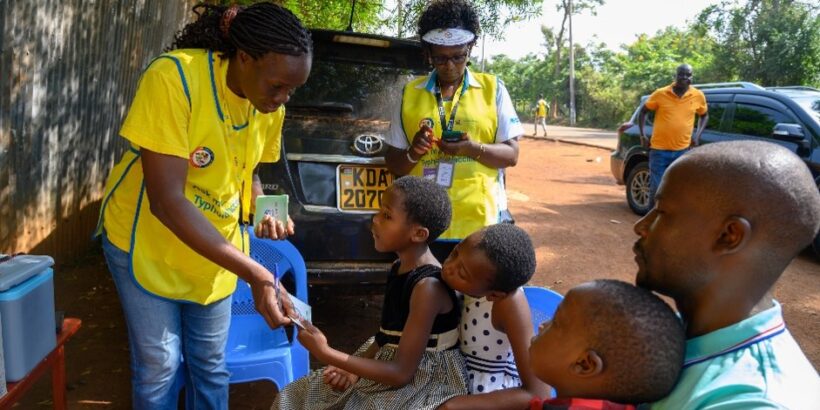
Cover photo: A vaccinator gives a TCV vaccination card to a child in Busia County, Kenya, during the country’s TCV introduction campaign in July 2025. Credit: TyVAC/Martin Mwangi.