
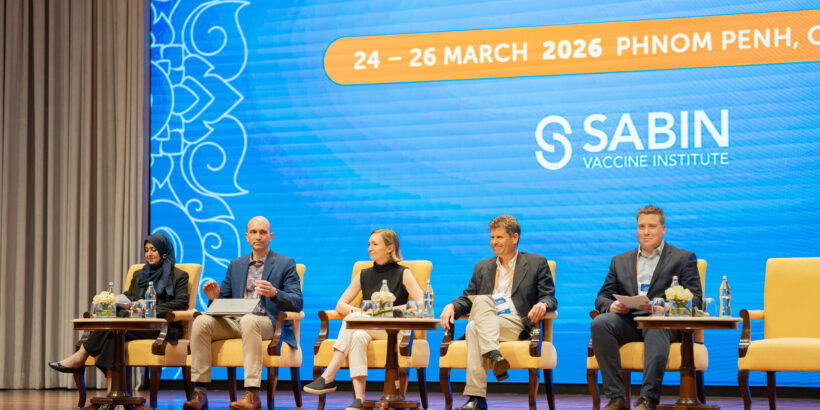
In March 2026, the 14th International Conference on Typhoid and Other Invasive Salmonelloses brought together more than 250 researchers, policymakers, and health experts in Phnom Penh, Cambodia to discuss the future of typhoid prevention. Over the last decade, the global community has made great strides toward a typhoid-free future—including reaching nearly 150 million children with typhoid conjugate vaccines (TCV) through introduction campaigns. More than 960 million people also gained access to safe drinking water from 2015 to 2024, increasing global coverage from 68 percent to 74 percent.
This year’s gathering centered on innovation and equity, focusing on how to expand protection against typhoid to the communities that need it most. Across plenaries, symposia, and poster sessions, participants explored topics ranging from drug resistance and disease surveillance to country experiences with TCV introduction and real‑world vaccine effectiveness.
Here are four key insights from the conference.
1. TCVs are making a measurable impact across the globe.
From Malawi to Nepal, researchers from around the world shared results affirming what we know about TCVs: they provide safe, long-lasting protection against typhoid for at least four years. To date, nine countries have introduced TCV into their routine immunization programs, including four countries in 2025—Burkina Faso, Kenya, Bangladesh, and Niger.
During a symposium on TCV introduction and impact, speakers underscored the role of data and surveillance to support country decision‑making. In many settings where blood culture confirmation is limited, countries are increasingly relying on triangulated data—combining information from hospital records, surgical outcomes such as typhoid intestinal perforation, serological data, and trends in neighboring countries—to build a clearer picture of disease burden. This approach can help inform country decision-making on TCV introduction, even in the absence of gold-standard data.
2. Addressing drug resistance is increasingly urgent.
Drug‑resistant typhoid emerged as one of the most pressing challenges discussed at the conference. Speakers highlighted the continued spread of extensively drug‑resistant (XDR) strains and raised concerns over reports of reduced susceptibility to last‑line antibiotics, including meropenem. “The emergence of XDR has fundamentally changed the landscape of typhoid,” said Dr. Farah Qamar of Aga Khan University in Pakistan.
Participants emphasized that slowing the spread of drug resistance will require a multifaceted approach. Vaccination with TCV remains a cornerstone, reducing infections and therefore the need for antibiotics. Panelists also highlighted the importance of antimicrobial stewardship, expanded diagnostic capacity, strengthened surveillance systems, and sustained investments in water, sanitation, and hygiene (WASH). Together, these tools can help protect both individual patients and the effectiveness of antibiotics for future generations.
3. Innovation in vaccines and research is shaping the next phase of typhoid prevention.
The conference also showcased exciting innovation in the typhoid research and development pipeline. Several presentations explored the potential of combination vaccines, including candidates that could protect against both typhoid and paratyphoid, or typhoid and invasive non‑typhoidal Salmonella (iNTS).
Discussions focused not only on scientific feasibility, but also on country appetite, programmatic fit, and how such vaccines could simplify delivery and expand impact in high‑burden settings. Researchers also shared progress on identifying correlates of protection (immune markers that show someone is protected) for TCV, a critical step toward accelerating vaccine development and evaluation.
4. Eliminating typhoid will require sustained commitment and global collaboration.
A unifying theme throughout the conference was that preventing typhoid is more urgent—and more complex—than ever. Climate change, rapid urbanization, conflict, displacement, and the spread of drug resistance are all increasing vulnerability to typhoid in different parts of the world.
“TCVs deliver real, population-level impact,” said Dr. Matthew Laurens, Director of the Typhoid Vaccine Acceleration Consortium (TyVAC), during the conference’s closing panel. “These outcomes are no longer hypothetical.” The challenge now, he noted, is maintaining the momentum to implement TCVs and other interventions within a shifting landscape.
Speakers repeatedly emphasized that progress to date has been driven by collaboration across various countries, disciplines, and sectors. As the conference concluded, participants left with a renewed sense of urgency and optimism: with sustained commitment and coordinated action, a typhoid‑free future is within reach.
Cover photo: Panelists speak at the 14th International Conference on Typhoid and Other Invasive Salmonelloses in Phnom Penh, Cambodia. Credit: Sabin Vaccine Institute.