
Pour lire ce blog en français, veuillez cliquer ici.
This month, the world will come together to cheer on their favorite national football (soccer) team as the World Cup kicks off with 48 countries and a total of 104 games. While we only see the teams on the world stage for a brief 5-week period, the years of work leading up to the games is what really matters. A team doesn’t win or lose the World Cup in five weeks; tournaments are won and lost as the teams practice, and play, and compete together in advance of the tournament. Strategies are honed and teams step onto the pitch as a unit.
Similarly, vaccine introduction campaigns are not only successful because of the days or weeks that campaign activities are underway. Introductions of new vaccines, such as typhoid conjugate vaccine (TCV), can take years before a child is vaccinated. Children are reached after extensive planning and strategizing.
When policymakers review data about typhoid burden, analyze information about drug resistance, and consider their new vaccine introduction queue, they set policy change in motion. When national immunization technical advisory groups and interagency coordination committees approve TCV introduction for the introduction work to begin.
Gavi, the Vaccine Alliance, reviews requests from countries for vaccine support and—much like a World Cup referee—determines how the game can move forward. If a country is approved, the ball advances. If not, partners in country may need to re-strategize and try their case with Gavi again.
When Gavi – the referee – blows the whistle with an approved application for the game to continue, entire teams of players jump into action. UNICEF Supply Division begins procurement; Expanded Program for Immunization managers identify the teammates who can help deliver on a successful TCV campaign. Each partner and player knows their role, focused on advancing the ball to reach every eligible child with TCV. Just as World Cup teams train together, learning each other’s moves, skills, and assets, partners working on a TCV introduction campaign are familiar with each other’s roles, strategic support, and capabilities. In football and in vaccination campaigns, every player and every partner is crucial.
Vaccination campaign teams, just like football teams, learn to coordinate, communicate, and trust each other. There is shared recognition of the goal at hand – a shared goal that goes beyond the pitch, scoring a major win by reaching children with TCV.
This year’s World Cup includes several countries with endemic typhoid: Cote d’Ivoire, Democratic Republic of the Congo, Ghana, Haiti, and Senegal. While we root for these teams – and many others – we can’t lose sight of the roles we each play to reach every child with TCV. As teams step into the global spotlight, representing their home nation, we must acknowledge the teamwork that it will take to protect children from typhoid and other infectious diseases.
The World Cup happens just once every four years, drawing a global spotlight and captivating attention of millions of passionate fans around the world. But whilst we celebrate football, let’s not forget the urgency to ensure that children around the world are always protected, able to grow into avid football supporters, partners (and players!)
Winning a World Cup is no small task – it takes years of passion, determination, and perseverance. Protecting every child with TCV is no different: we must continue to come together as a team, each playing our role and doing our part, to share the same victory.
Just like during the World Cup, we love to celebrate victories. The most beautiful win is when children are protected against typhoid and other childhood diseases. When children are safe, we all get to lift the trophy together, thanks to vaccination!
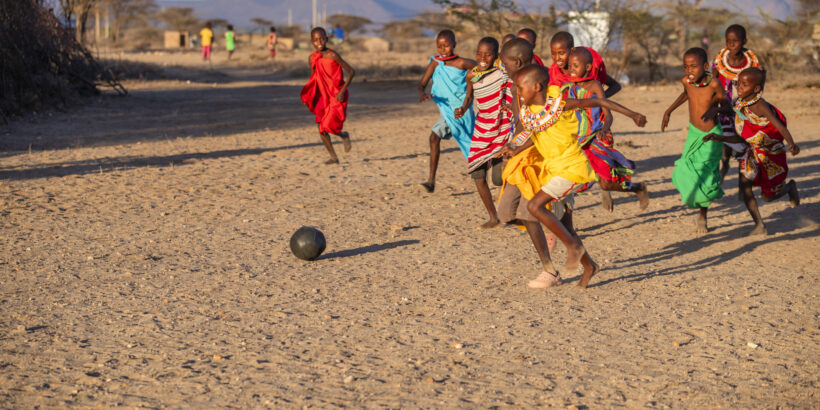
Cover photo: Children from the Samburu tribe in north-central Kenya play football in their village. Credit: iStock.