
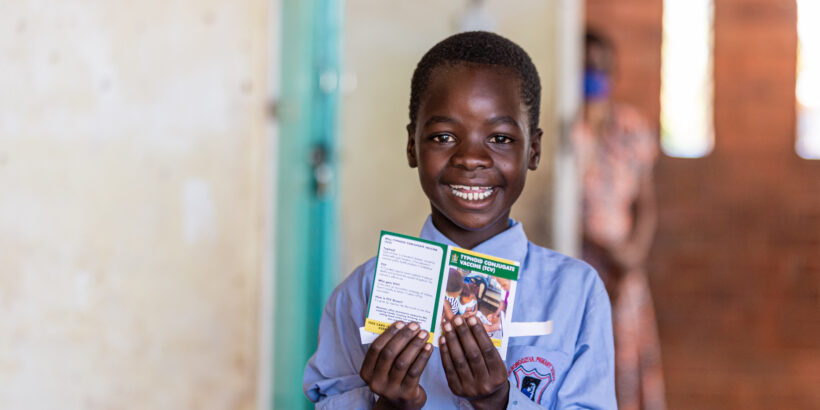
Although the global burden of typhoid remains high, it has often been overlooked as a health priority. Ongoing concerns about drug resistance, climate change, and rapid urbanization underscore the urgency to address typhoid. Since 2017, global policies have been put into place to help countries prioritize effective and efficient typhoid prevention and control.
SAGE recommendation
Following a careful review of available information and data on typhoid conjugate vaccines (TCVs) in October 2017, the Strategic Advisory Group of Experts (SAGE) on Immunization, an advisory body to the World Health Organization (WHO), recommended TCVs for routine use in infants and children older than six months of age in typhoid-endemic countries. They also recommended prioritizing TCV introduction in countries with the highest burden of disease and/or a growing burden of drug-resistant typhoid, and in response to confirmed outbreaks.
TCV prequalification
In December 2017, WHO prequalified the first TCV, Typbar TCV®, signifying that the vaccine meets international standards for quality, safety, and efficacy, and allowing UN agencies, including UNICEF and Gavi, the Vaccine Alliance, to procure the vaccine for use in low- and middle-income countries. In December 2020, WHO prequalified a second TCV, TYPHIBEV®, increasing vaccine options and supply available to countries. In 2024, WHO prequalified two additional TCV products—SkyTyphoid™ and ZyVac® TCV —and in 2026, WHO prequalified EuTYPH-C Inj.® Multi-dose, bringing the total number of WHO-prequalified TCV products to five.
WHO position papers on typhoid
In March 2018, WHO published a new position paper, which replaced their previous 2008 position paper, formally recommending preferential programmatic use of prequalified TCV for all ages “in view of its improved immunological properties, suitability for use in younger children and expected longer duration of protection.” WHO also recommends prioritizing the introduction of TCV in countries with the highest burden of typhoid and/or a high burden of drug-resistant typhoid. The position paper reemphasizes the importance of an integrated approach to typhoid prevention and control. It recommends using vaccines alongside improvements in water, sanitation, and hygiene interventions.
In August 2026, WHO published a new position paper, replacing its previous 2018 and 2008 position papers, which reaffirmed its recommendation for the use of TCV for routine immunization programs in typhoid-endemic countries. TCV is recommended at all eligible ages in view of its improved immunological properties as compared to ViPS and Ty21a vaccines, its suitability for use in younger children, its longer duration of protection and programmatic advantages.
The position paper recommends the use of TCV in settings with: 1) high or very high incidence or 2) a high case fatality ratio or 3) a high burden of antimicrobial resistant Salmonella Typhi. The first dose is recommended at 9–24 months of age. In countries with a high burden of typhoid or high rates of drug-resistant typhoid, WHO recommends a booster dose, particularly for children who received a first dose younger than 2 years of age. Countries may also consider delaying an initial dose of TCV until a child is closer to school age, based on local epidemiology and feasibility.
GACVS review
The Global Advisory Committee on Vaccine Safety (GACVS) is an independent expert body that advises WHO. In December 2018, GACVS reviewed new data on more than 340,000 children and adolescents vaccinated in TCV introduction studies in Bangladesh, India, Malawi, Nepal, and Pakistan. GACVS confirmed that Typbar TCV is safe for widespread introduction. As additional data become available, GACVS continues to review the information and update its reports.
Gavi, the Vaccine Alliance
Every five years, Gavi develops its Vaccine Investment Strategy (VIS). This strategy determines which vaccines will be available through Gavi’s support programs. In 2008, Gavi prioritized typhoid vaccines for inclusion in the VIS. However, since polysaccharide typhoid vaccines are not suitable for infants and TCVs were on the horizon, Gavi made no financial commitment at that time.
Following the SAGE recommendation for TCVs, in November 2017, the Gavi Board approved funding to support TCV introduction in Gavi-eligible countries. Applications for country support opened in 2018.
Pakistan became the first country to introduce TCV into its routine immunization program in November 2019. Liberia and Zimbabwe introduced TCV into their routine immunization programs in 2021. Nepal followed, introducing TCV into its routine immunization program in 2022. Malawi introduced TCV into routine immunization in early 2023, followed by Burkina Faso, Kenya, Bangladesh, and Niger in 2025.
In 2026 Gavi began a new strategic period focused on four goals, including the introduction and scale-up of vaccines. Gavi-eligible countries are encouraged to evaluate their vaccine priorities to appropriately optimize the vaccine programs for the local context. Decision-makers can consider how TCV fits into their routine immunization schedule, focused on vaccines for prevention of endemic, epidemic, and pandemic diseases. The funding available to countries for TCV introduction and routine immunization (and their other vaccine priorities) is based on specific country vaccine budgets developed and disseminated by Gavi to individual countries.
Additional information:
Photo: PATH/Kudzai Tinago.