
This blog was originally posted on the Sabin Vaccine Institute website.
Typhoid fever is a life-threatening infection that the World Health Organization estimates affects 9 million people each year, mostly in places with no access to sanitation to destroy the Salmonella enterica serotype Typhi bacteria that causes it. Although it can be treated with antibiotics, more than 100,000 die of typhoid each year. Treatment is becoming more difficult as the bacteria develops resistance to antibiotics.
In advance of the 14th International Conference on Typhoid and Other Invasive Salmonelloses coming in March 2026, we showcase our conversation with Dr. Matthew Laurens, Director of the Typhoid Vaccine Acceleration Consortium (TyVAC), one of the sponsors of the conference. As he discussed in a recent episode of Sabin’s Getting to Zero webcast, Dr. Laurens notes:
- It is difficult to know how many cases of typhoid occur each year in every country
- Typhoid vaccines are protective, but not part of many childhood immunization schedules
- Ongoing research will answer many questions about vaccines, including how long protection lasts
What is the current global burden of typhoid and why does it persist to such high levels despite a vaccine?
I have to preface my response with the fact that we don’t have a great handle on the number in terms of the entire burden of disease of typhoid worldwide. There is wide variation in terms of what we know about the total burden. Most of these cases are happening in parts of Asia and in sub-Saharan Africa, and disproportionately children are affected.
Why is typhoid so difficult to track?
Typhoid is difficult to diagnose because it shares many of the signs and symptoms with other diseases common in areas where it is endemic. For instance, malaria and dengue fever often share the same symptoms of fever, fatigue, and malaise. To really diagnose typhoid, you need a blood culture specimen. In many areas where typhoid remains, capacity for taking a blood culture for diagnostics is quite limited, if it exists at all. In some countries, it might only exist in a single research laboratory. So, making the diagnosis of typhoid is extremely difficult and therefore estimating the entire burden of disease is even more difficult.
How do we protect against typhoid?
We know that provision of safe drinking water is the single most life-saving public health intervention that can be provided to communities. The reason why that hasn’t happened is essentially a question of cost and infrastructure. It’s very expensive to provide clean drinking water and establish hygiene-protective measures in communities. And because many low- and middle-income countries lack the resources to establish these systems, they are not able to have the clean and safe drinking water that many of us are able to obtain in industrialized countries.
The only thing we can do in the interim is provide other protective measures such as vaccination.
How effective is the current typhoid conjugate vaccine and how long does the protection last?
The current typhoid conjugate vaccines (TCV) have been tested in Phase 3 studies in Bangladesh, Malawi, and Nepal. And these initial studies looking at children nine months of age and older show that TCV has an effectiveness of around 80 percent. And that effectiveness is extremely high for a conjugate vaccine, especially for a single-dose vaccine that can be given and achieve high levels of protection. We know from studies in Malawi, this protection lasts for four years, potentially longer, and studies are ongoing to determine exactly how long that protection lasts.
How long do the current vaccines last?
Typhoid conjugate vaccines are currently targeted to areas that are at highest risk for typhoid, including children, both school-age and under the age of five. The question remains as to how long this protection lasts. We are investigating to see where a second dose of typhoid conjugate vaccine might be indicated. It’s not currently indicated. Again, we don’t know exactly how long that protection lasts, but are there areas or targeted populations that could benefit from a second typhoid conjugate vaccine dose? That’s one piece that we’re continuing to assess.
If you had a magic wand to prevent typhoid, what would it be?
If I had my way to prevent typhoid in the areas and populations that are most affected, I would want a vaccine that could be administered as part of a multivalent vaccine such that children, when they’re injected with a single dose of vaccine could be protected against multiple diseases, including typhoid. We know that such vaccines exist and if typhoid could be added to that regimen, that would be wonderful to avoid multiple needle sticks in children. Also, for that vaccine to have very long protection and 100 percent efficacy in prevention against disease to ensure that a child would have a long and healthy, productive life free of typhoid.
Is this why many countries have not yet introduced typhoid conjugate vaccines into their national immunization programs?
There are two answers to that question. One is that some countries might not have a clear picture of the burden of typhoid in their region and in their country in particular. So that goes back to the issue with diagnostics. They might only see the very severe cases that only make it to the referral hospitals and don’t know exactly the burden of typhoid at the community level. With other preventive measures that are also available, countries have to pick and decide which ones to prioritize.
The second reason is that multiple vaccines are currently being introduced in many regions. These include vaccines that are newer, including for malaria, rotavirus, or pneumococcus vaccines. So, countries are faced with a very large vaccination schedule and very limited resources to conduct vaccination campaigns and routine immunizations.
What is the solution?
Strengthening the health structure of countries to deliver vaccines, to deliver basic healthcare is essential if we are to advance health and prevent death in pediatric populations and in communities globally. In addition, we need to continue to support research efforts to document how large the burden of disease is in these areas. In the United States, we’ve seen significant cutbacks in terms of foreign aid and assistance to areas where typhoid is endemic. We need to bridge that gap and continue to provide resources to these areas so that they can achieve the health that every child deserves.
How does the rising antibiotic resistance in Salmonella Typhi, the bacteria that causes typhoid, change the prevention conversation, particularly around vaccines?
Certainly, the trends in antimicrobial resistance are alarming. We also have very few new antimicrobials being developed that target diseases, especially diseases that are no longer present in developed or industrialized countries, like typhoid. So essentially this means that eventually some areas might have cases of typhoid that cannot be successfully treated with antibiotics, which means essentially a death sentence for those who are diagnosed.
This is a terrible scenario and one that we want to avoid. And one way to do that is to introduce vaccination campaigns that would provide essential protection to populations against typhoid. And this would avoid the need for antibiotic use altogether, because you’re preventing disease or at least reducing the burden of disease significantly, such that it becomes less common to use antimicrobials. Then, when you do need to use antimicrobials, you are less likely to induce resistance of an organism to antibiotics.
The Typhoid Vaccine Acceleration Consortium (TyVAC) has been central in advancing typhoid conjugate vaccines globally. What role do you see TyVAC playing over the next 5 to 10 years?
An encouraging development is that that countries that are endemic for Salmonella Typhi are introducing typhoid conjugate vaccines with the help of TyVAC, through multiple collaborations and partners at the regional, national and international levels.
A few countries introduced the vaccines in 2025. We expect to help countries after they introduce to assess the impact of vaccination. How does it impact disease in these populations, helping them to measure that impact so that they can determine what the public health benefits are and then look at needs for subsequent vaccinations in the future. And also, helping to document how long this protection lasts in populations is another priority for TyVAC.
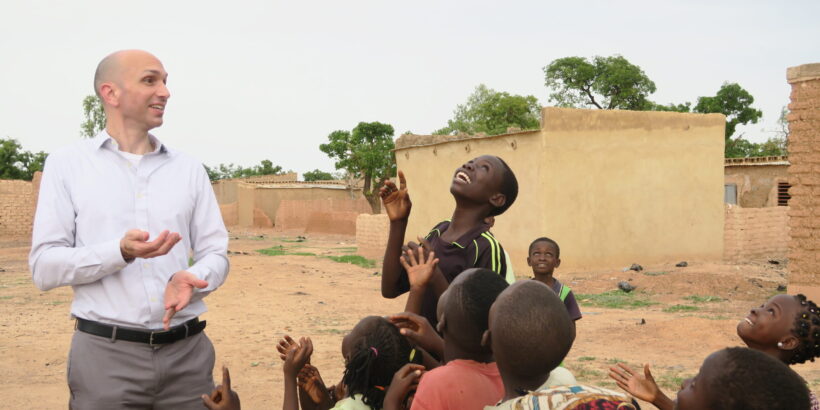
Cover photo: TyVAC Director Dr. Matthew Laurens pictured with a group of children. Credit: University of Maryland.